




How to Increase Online Sales in Nigeria


There is a story you know.
You launched your business, posted, prayed, and refreshed your DMs every twenty minutes, waiting for that first serious buyer. And then the sales came, slowly. Although they were inconsistent, they came. You fulfilled orders, you told your friends, and you felt like something real was starting.
Then it suddenly stopped.
It didn’t stop overnight. It just slowed down. The same amount of effort started producing fewer results. It became hard to get new customers. Prices started being questioned. New sellers appeared, selling something similar, cheaper, and doing better numbers than you.
Now you started to wonder: “Is it the economy? Is it just not my time yet?”
Look, the problem is rarely timing. The problem is that the strategies that got you to where you are cannot take you where you want to go.
Somewhere between starting and scaling, Nigerian entrepreneurs hit a stop, mainly because they are running the same play on a field that has changed around them.
This article is about how to increase online sales through specific shifts that actually move the numbers for Nigerian sellers operating in this economy and market, right now.
What “Knowing How to Increase Online Sales In Nigeria” Means
Before the strategies, let’s look into what we are actually solving for.
Many people think increasing online sales means getting more followers and more visibility. While those things help, they are not the root answer.
You can have ten thousand Instagram followers and make N30,000 in a month. You can have two hundred highly targeted WhatsApp contacts and make N300,000.
The difference is conversion (turning the attention you already have into actual transactions).
So when we talk about how to increase online sales, we are asking two separate questions simultaneously:
“How do I attract more of the right people?”
“How do I convert the right people?”
Most entrepreneurs are only trying to answer the first question. The fastest money, however, is almost always in the second one. Because the people who have already found you and followed you are the warmest leads in your funnel. They are one good reason away from becoming customers. And most Nigerian sellers are fumbling that reason every single day without realising it.
Keep that thought. We will come back to it.
1. Sell to One Person
There is a market woman in Balogun who has been selling ankara fabric for thirty years. She has no Instagram page, no digital marketing budget, and no formal business training. But she knows her customers so well: their age, budget, occasion, preference for particular prints… she knows her customers so well that she can close a sale in four minutes.
That level of customer knowledge is what most online sellers are missing.
When your product description reads “perfect for all occasions and all skin types and all ages,” you are not appealing to everyone.
The human brain is wired to feel understood before it feels safe enough to buy. And you cannot make someone feel understood when you are talking to the entire population at once.
If you really want to increase online sales, you need to do the uncomfortable work of knowing your customer.
Know what your customer is worried about.
Know what makes your customer buy instantly.
Know what kind of caption makes them stop.
Know what objection she raises before she buys, and what finally pushes her over to say, “Send your account number.”
How to apply this:
Write down the single most specific description of your ideal customer. Not “women aged 18–35 in Lagos.” Go deeper. What does she do for work? What does she spend money on without thinking? What does she complain about to her friends? What would she never compromise on, even when money is tight?
Then rewrite your product descriptions, your captions, and your WhatsApp broadcast messages as if you are speaking directly to that one person.
Watch what happens to your sales.
2. Your Sales Page Is Leaking
Have you ever thought critically about the experience a stranger has when they land on your page for the first time?
Don’t assume that if you can just get someone to your page, the product will sell itself. No, it won’t.
A stranger landing on your page is doing a silent assessment in less than five seconds. They are asking: Does this look real? Does this look like quality? Can I trust this person with my money? If the answer to any of these is unclear or uncertain, they leave.
This assessment is lost or won by a combination of certain things, which include:
Product Photography
A blurry photo in front of a rumpled bedsheet is not just unappealing; it signals low quality before the customer has read a single word. In the absence of physical touch, the photo is the product.
It does the sensory work that the customer cannot do from their phone screen. Invest in this. Even if it means borrowing a friend’s better camera, shooting near a window with natural light, or using a clean, simple background you create with a N1,500 plain sheet of fabric.
This one change alone can lift conversion rates dramatically.
Product Description
“Quality materials. Fast delivery. DM to order.”
That’s not a product description. It’s a placeholder.
A real product description tells a story of what the product is, why it exists, what problem it solves, how it will make the buyer’s life better, or how it will make them feel. It handles objections before the customer raises them and gives the buyer language to use when they are describing your product to others.
Social Proof
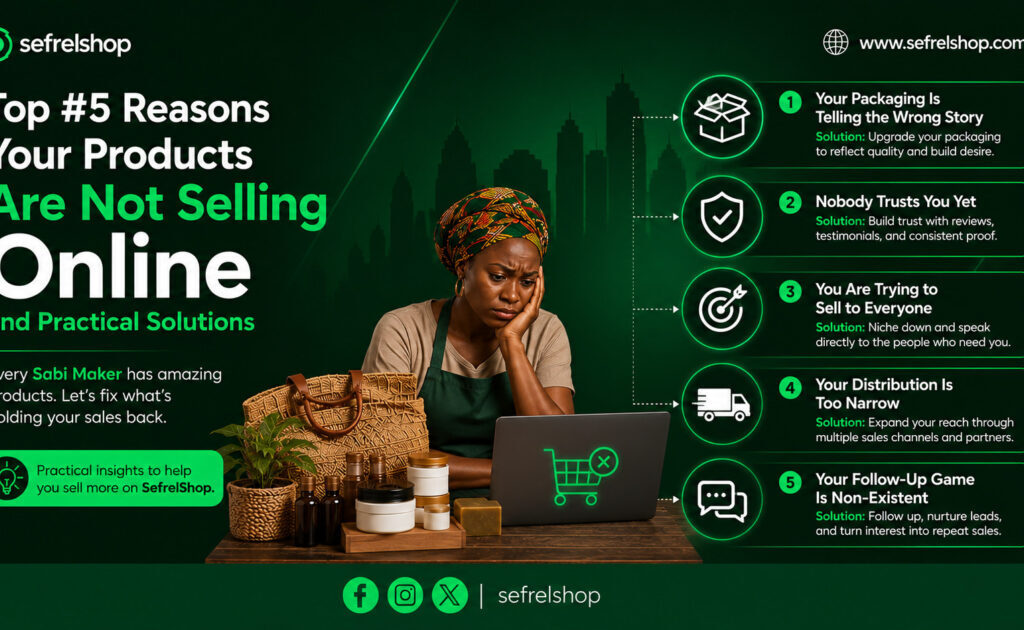
On a page with zero testimonials, a stranger is being asked to trust you based entirely on your own word. That is a big request in a market where online scams have conditioned buyers to be suspicious. A page with ten customer reviews, photos, and testimonials is a completely different sales environment. The previous customer does the convincing so you do not have to.
To increase online sales, your page must earn trust in seconds. If it is not currently doing that, no amount of additional traffic will fix the problem. It will only amplify it.
3. The Game of Profit
In 2023, a study by Marketing Doughnut found that 80% of sales require at least five follow-up contacts after the initial conversation, yet 44% of salespeople give up after just one follow-up.
Now think about how that translates to a typical Nigerian online seller’s reality.
Someone DMs you on Instagram asking about a product. You respond with the price and details. They say, “Okay, let me think about it.” You say, “Okay, no problem.”
And that is where the conversation ends.
Three days later, you are wondering why your sales are slow. That person has not thought about your product again because life has happened to them. NEPA took the light, a work emergency came up, they saw something else interesting on their timeline. They did not forget you forever. They just needed one more touch to bring them back.
You never gave it.
This is the follow-up gap. And it is costing Nigerian entrepreneurs more money than they realise.
The fix is not complicated. It is just consistent.
After every sales conversation that does not close, follow up once, not immediately, but within 24 to 48 hours. Keep it simple: “Hey, I just wanted to check if you had any other questions about Cinnamon Tea.“
That one message will close a percentage of conversations that your silence was losing.
For your existing customers, build a structured follow-up system. After delivery, check in to confirm they are happy. A week later, share something useful, a tip, a new product, or a piece of content they would enjoy.
It should not always be a sales pitch. Just make sure you’re present. Consistency in follow-up is one of the fastest ways to increase online sales without spending a single naira on advertising.
4. Urgency Is Not Manipulation
“DM to order. Available in limited quantities.”
Everyone writes this. Nobody believes it anymore.
Real urgency is one of the most powerful conversion triggers in commerce. The challenge is that fake urgency has been so overused in Nigerian online selling that buyers have developed immunity to it. When everything is always “limited stock,” limited stock means nothing.
Real urgency works differently.
Real urgency sounds like: “I only have 8 pieces left of this exact design, and I am not restocking until March.” Or: “The price goes up by N2,000 from Monday. This is the last week at the current rate.” Or: “I am taking orders for December delivery only until the 15th of this month because production takes three weeks.”
These statements are specific. They are believable because they are rooted in the reality of your business. And they give the buyer a concrete reason to make a decision today instead of pushing it to “later.”
Build urgency into your selling honestly. Know your actual stock levels and communicate them. Know your production timelines and let buyers know when a window is closing. Know your pricing schedule and give advance notice when prices are changing.
Honest urgency respects the customer’s intelligence and still drives the action you need.
5. The Platform You Sell On
Every platform your product lives on sends a signal to the buyer about the quality of your product before they read a single word of your description.
A product sold through WhatsApp status updates, where the seller is posting twelve times a day alongside memes, voice notes, and political arguments, arrives in the buyer’s mind in a particular frame. It might be a great product. But the environment it is being sold in communicates something else, not quality.
A product on a premium marketplace, one with clear positioning, a trusted reputation, and a selective onboarding process, gives a completely different vibe.
The platform’s credibility becomes part of the product’s credibility, and the buyer feels safer before they have even read the description.
This is not even a theory. You see it in your own buying behaviour. The same product on Jumia, on a random WhatsApp status, and in a premium boutique feels different in all three contexts.
Even if the product is physically identical. Context shapes perception. Perception drives sales.
Which is why, for Nigerian entrepreneurs serious about increasing online sales, where you sell matters as much as what you sell.
And this is where SefrelShop enters the conversation, not as an afterthought, but as a strategic asset.
SefrelShop is Nigeria’s premium digital marketplace for locally made lifestyle products. It was built for one specific purpose: to give quality Nigerian brands a platform that matches their value. Fashion, skincare, food, accessories, home goods, art… as long as it is locally made and excellent, it belongs on SefrelShop.
6. Content Is Your Lowest-Cost Sales Channel
The Nigerian entrepreneurs who are growing the fastest right now are not the ones spending the most on ads. They are the ones who have built an audience that trusts them through valuable content.
Content marketing works on a simple principle: if you help someone before they buy from you, they are far more likely to buy from you when they are ready.
For a seller trying to increase online sales without multiplying their marketing budget, listing on SefrelShop is not an optional extra. It is a strategic move.
A skincare brand that posts educational content about ingredients, skin types, and common mistakes, and just happens to sell skincare, creates a different relationship with its audience than a brand that only posts “new arrivals, DM to order.”
One brand is a resource. The other is a vendor. And in a crowded market, people pay more and buy more often from brands they see as resources.
You do not need a massive content budget to make this work. You need clarity about what you know that your customer wants to learn, and the consistency to share it regularly.
A food brand could post weekly meal prep tips. A fashion brand could post styling guides for different body types. An accessories brand could post content about how to dress for specific occasions. A home goods brand could post interior styling tips.
None of this requires a production crew or a content team. It requires knowing your customer well enough to know what they find useful.
Over time, content like this does something no single ad campaign can do: it builds an audience that shows up already trusting you. And an audience that already trusts you is the easiest audience in the world to increase sales from.
7. You Have a “Perception Problem”
We cannot talk about how to increase online sales without addressing the most common excuse Nigerian entrepreneurs give for slow sales.
“People don’t have money.”
Maybe some of them don’t. But some of them bought something else this week. They bought from another seller. They ordered food three times. They topped up their data. They found money for something they valued enough to spend on.
The question is not whether your customer has money. The question is whether your product has been positioned to feel worth the money they have.
When a buyer looks at your price and says, “This is too expensive,” they are not usually saying they cannot afford it. They are saying: I can’t see enough value here to justify this price.
That is a positioning failure.
The fix is to increase the perceived value of what you are selling through better packaging, stronger storytelling, clearer communication of what makes your product different, and a brand environment that reflects the quality you are offering.
Nigerian consumers pay premium prices every day for foreign products, for certain local brands, and for experiences they believe are worth it.
The keyword is believe. Belief is built through branding, consistency, and the cumulative impression your business creates over time.
Work on what your product feels worth.
8. The Most Underused Growth Strategy in Nigerian E-Commerce
After everything- better photos, better copy, follow-up systems, content strategy, platform selection… the single most underused strategy for increasing online sales in Nigeria is this:
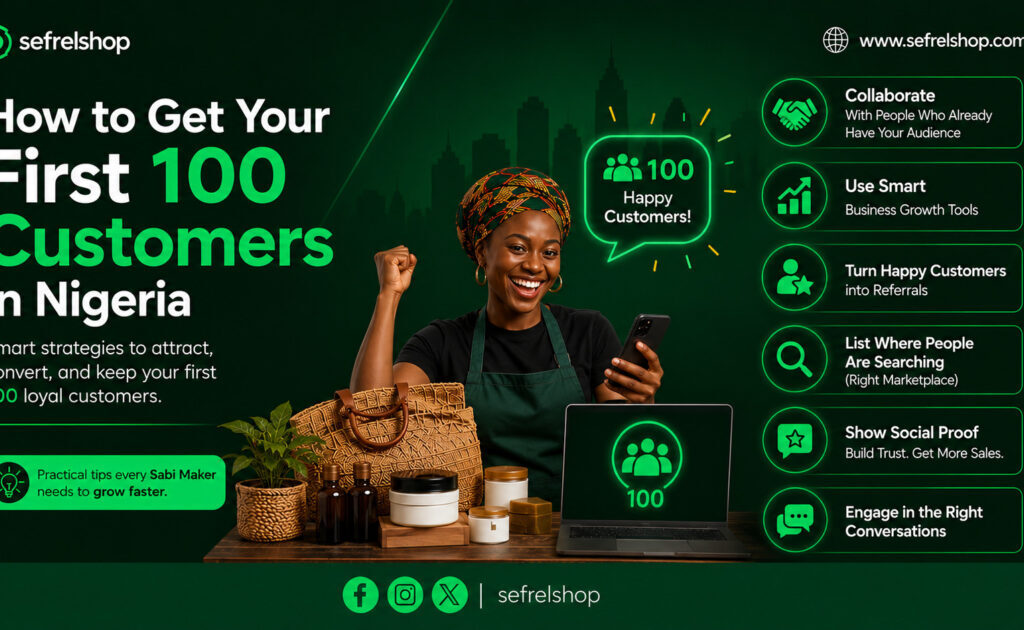
Ask your happiest customers to tell someone.
Not with a “feel free to refer a friend” caption that nobody reads. Say it directly, personalised with intention.
After a successful delivery, send a message: “I’m so glad you love it. If you know anyone who might want something similar, I would really appreciate it if you sent them my way.”
Word of mouth has always been the most powerful sales tool in Nigerian commerce, from the market women who have been “packaging” their customers for decades to the Instagram pages that blow up because one influential person shared a post. The mechanism is the same.
Do not leave it to chance.
The Reason Sales Feel Hard Right Now
If you have read this far, you are not the kind of entrepreneur who gives up easily. You are someone who is genuinely trying to figure this out.
Sales feel hard in Nigeria right now for real reasons. The economy is truly difficult, and inflation has squeezed purchasing power in ways that are not trivial.
These are real factors, and dismissing them entirely would be dishonest.
But here is what is also true: Nigerian consumers are still spending every day. On products and brands that have done the work of earning their trust and communicating their value clearly.
The market has not dried up; it has just become more selective. Buyers who used to make instant purchases are now pausing to think.
That is not a problem for a seller who has done their work. In fact, it’s an unfair advantage.
Because when buyers become more selective, the brands that have built trust, consistency, and clear value win more of the business.
The shortcuts that used to work- fake urgency, copy-paste captions, and random posting- stop working first. The businesses built on real foundations keep growing while the shortcuts crumble.
Increase your online sales by building something real. Something that earns trust. Something that communicates value without apology.
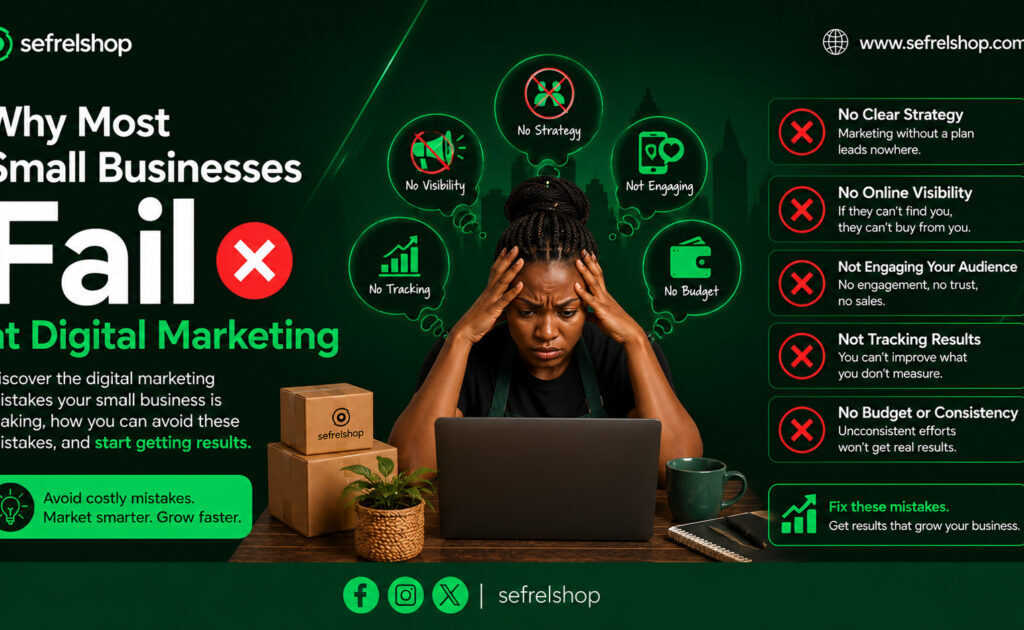
Now that you know how to increase online sales, see the top reasons why most small businesses fail at digital marketing.